Showing posts with label schema. Show all posts

Tuesday, 15 November 2011

In out

About a year ago I posted a similar post on 3d object fitting. I have now added two additional objects and containers, I had lost the box and the cube (but found today)
I will keep them in this box, in keeping with theme although initially not with lid on.

Saturday, 5 February 2011

Bottle filling

On closer inspection of old photos it would seem we have done a fair few bottle filling activities, all of which have been well received particularly for those with enclosure schemas.
Putting pasta bows into wide necked bottles (they could be shock out after and reused)
Rice scooped carefully into the bottle and then poured out again, to do it all over again!!!
Placing gems and pom-poms into a bottle

Friday, 14 January 2011

3d object fitting

Sorry no post yesterday, not broken new years yes before the month is out. Suddenly my broken IPhoto worked and so I have found a wonderful bunch of lost photos and been able to upload lots that I couldn't perviously, I am very happy indeed!!!!! So here starts my first post with found photos, I chose this as it was a lovely activity that I had not thought about for a while.


A lovely infant activity which simply involves putting the shape into the correct (or not as the case maybe) in and out of the matching container. Great for children going through a joining or enclosure schema. I got the inspiration from nienhuis but think my version is just as wonderful at a fraction of the price (I am however in the hunt for a nice wooden box for this activity but at the time the cube and box were real favourites)

Tuesday, 28 December 2010

Christmas fine motor (hanging and transfering)

Ok, so always on the look out for ideas where children are encouraged to develop their fine motor skills whilst incorporating favoured schemas.

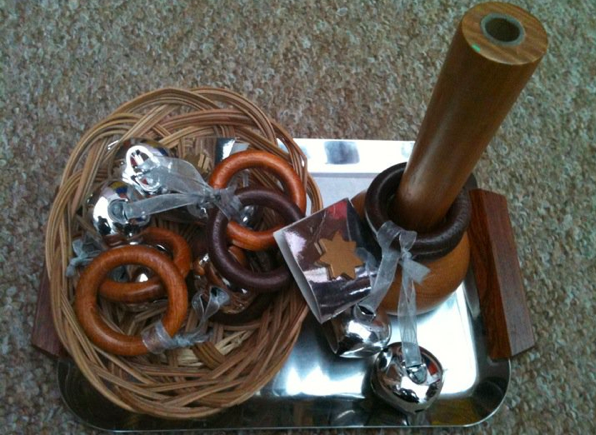
Bells from gift tags (complete with tags, how the survive is anyones guess) attached to small curtain rings and placed onto a wooden single stem vase. These can be used as a simple transferring activity or as often are in conjunction with a song jingle bells/ twinkle twinkle again needing a pincer grip rather than a palmer grasp as with many bell instruments

Decorative Christmas candle rings, placed onto a kitchen roll pole, another favourite. Just adapting the good old curtain rings on a pole. Make sure the decorations are safe for children you are working with.


Little wooden gift tags (of course you could use card ones short term) to hang from a cup tree. This requires a little more skill and usually requires the use of two hands and finger control to separate the thread to hang.

For a more complex activity and incorporating the enclosure schema (always a favourite) placing a large seleacion of christmas decorations and tags in a selection of boxes and bags, stored inside a larger box, creates a natural curiosity. Whilst incorporating even more fine motor skills, and then when it comes to putting it away (which is equally fun) a whole bunch of problem solving, numeracy and reasoning skills to match lids. Lots of opportunities to talk about a range of mathematical concepts e.g. size, prepositions, 3d/ 2d shape, colour, weight, pattern, sorting, comparisons etc. If you choose your decorations accordingly you can also discuss the christmas story (which was my initial motivation for the activity, just kept adding more decorations to meet demand)
Happy Fine motor Christmas.

"He who can no longer pause and wonder and stand rapt in awe, is as good as dead: his eyes are closed." Albert Einstein

Monday, 9 August 2010

Paper and Magnet Construction

This ingenious construction is made using a collection of tins and jars with metal lids. The paper is stuck to each tin with a magnet. Creating a fabulous construction with lots of additional possibilities.

A great idea for developing fine motor skills for cutting and problem solving with lots of opportunities to discuss mathematical concepts such as lengths, angles and directions. The opportunity to identify magnetic and non magnetic items, cannot be missed either this is how all these items were collected and to be honest by the end of the construction I had no idea we had that many magnetic items. Great for those children who are really into linking schema. I'm thinking that next time we get the pens out to decorate the paper too.

"Life is "trying things to see if they work"." Ray Bradbury

Monday, 7 June 2010

Shower ring maths


Yes you read right! I got these shower curtain rings at a ridiculously low price, I got them simply to appease the connecting scheme we got going on. But realising the ring fits nicely into a hole punched hole, thought they made the perfect "next step" activity tying in interests. Will let you know how the go down.

I think this activity would be perfect for visual learners to understand sums/ number sentences (whatever your preference), particularly those with autism.
Also created the number cards
"You don't understand anything until you learn it more than one way." Marvin Minsky

Friday, 21 May 2010

Again!!!!! Connecting schema

... Don't worry no more buttons today, not to say not been played with, I'm just not going to talk about them. However I am going to discuss the reasons why we are a little obsessed by them currently, and it's all related to schema's, connecting to be precise.

When we observe children we often see patterns in their play and activity, whether we are looking for it or not, these patterns are referred to as schema. For example an infant repeatedly throwing toys out of pram (trajectory schema), toddler filling bags up with toys and moving around room (transportation and enclosure schema) etc. There have been many schema identified but common ones are:

Enclosure/ enveloping.

Connecting.

Disconnecting.

Trajectory.

Rotation.

Transportation.

Vertical Trajectory.

There are full descriptions in the links on the post about theCookie Cutter size puzzle, post. Observing children's spontaneous actions and play allows us to identify their dominant schema's and thus plan activities that extend learning by presenting activities through preferred format or engage further by offering more sustained activities around the schema.

"Schemas can be regarded as a window into children's learning.

Generally, when children are playing schematically they are intrinsically motivated to learn, resulting in long periods of concentration. Through their schemas, children are 'fitting' various experiences into their current thinking." (Colette Tait,16 December 2004, Nursery World)

Within your continuos provision ensure a range of resources to support children's current schema and enhance provision with resources that lend themselves to supporting particular schema's in an open ended way. For example with a connecting schema a collection of pegs can be used in a range of ways to enhance play and development and support the schema e.g. to secure sheets for a tent, simply clipping to things, joining papers together, attaching to string to join vehicles, attaching to string to make a fishing rod, pegging out washing etc.

Adult led and enhanced provision can also allow children to develop new skills through their schematic preference if adults are creative in their presentation of resources, providing appropriate activities and equipment. Using PLOD planning can be a useful brainstorming activity to allow you think think of ideas to support individual children's needs through dominant schema.

Again!!!!! Connecting schema

Here are a few more example of connecting schema:


"A pattern of repeatable behaviour into which experiences are assimilated and that are gradually co-ordinated. Co-ordinations lead to higher-level and more powerful schemas." Chris Athey, 1990

Thursday, 20 May 2010

Button it

We're still buttoning!!!, Think there's a bit of a connecting schema going on here!!
Button's on ribbon and threading felt rectangles.

Matching button dominoes and joining to make a snake.
'“Such experience is not just play. It is work he must do in order to grow up.'” Maria Montessori

Wednesday, 19 May 2010

Flower Power

On this week's theme, this flower buttoning activity has proved incredibly popular this week, it's always so exciting when something that has been around for a while suddenly becomes a favoured item. From the amount of times this (along with other buttoning activities) has been done this week we are going to have expert dressing skills!!

Today's quote is from three year old doing the buttoning after being told, "You have been working hard at doing those buttons and you did them, well done!"
"Yeah, and it is REALLY hard work... But I can do it now!!!"

Thursday, 13 May 2010

Creative kids...


After Tuesdays post about flower puzzle and enclosure schema, I suggested that I would probably do a little series on Schema. Just to remind me that children don't do what we expect and adapt activities in ways we don't even think of. Certainly many professionals are aversive to using templates for drawing around, but if it's initiated by child I say don't discourage!!

Another activity that does include an element of enclosure, putting pom-poms into a chocolate box. I had not intended the sorting of colours into lines, but I love it when kids spontaneously extend their own learning, as if they know exactly what they need. I guess montessori realised this, and also those who created a host of resources related to working with a child's schema.

And again, a child extends again. Think maybe flower related activities needed!!!
“And so we discovered that education is not something which the teacher does, but that it is a natural process which develops spontaneously in the human being.” Maria Montessori

Tuesday, 11 May 2010

Cookie Cutter size puzzle


Another quick post, which may lead to a little series on schema?? With children who do exhibit schema, enclosure is a particularly common one. When I found these cookie cutters @ you guessed it..."pound land" I thought these will be brill, lots of enclosure fun and tie in some size vocabulary and understanding!!!

A couple of great link about schema in practice

‘Schemas are patterns of linked behaviours, which the child can generalise and use in a whole variety of different situations. It is best to think of schemas as being a cluster of pieces, which fit together. (Bruce)